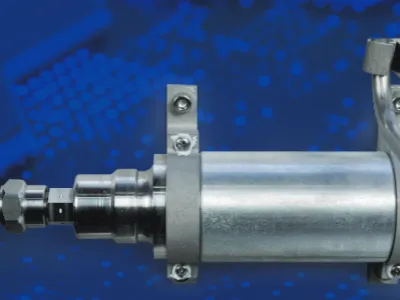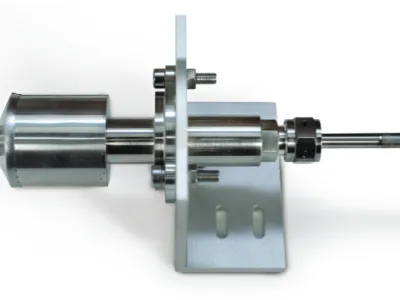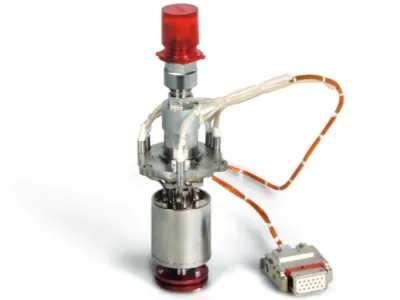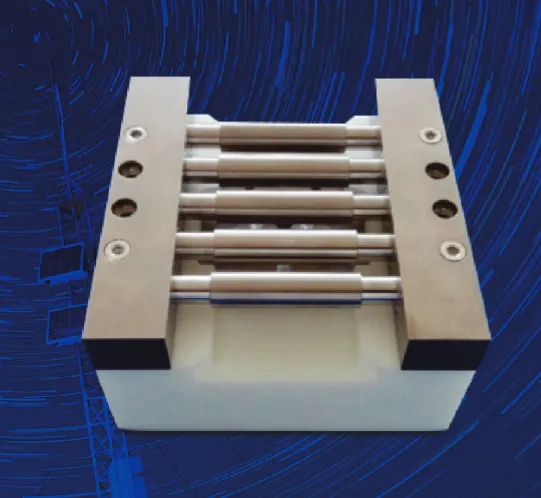
Visual Overview
Technical Details
Comprehensive specifications and technical information
Quick Overview
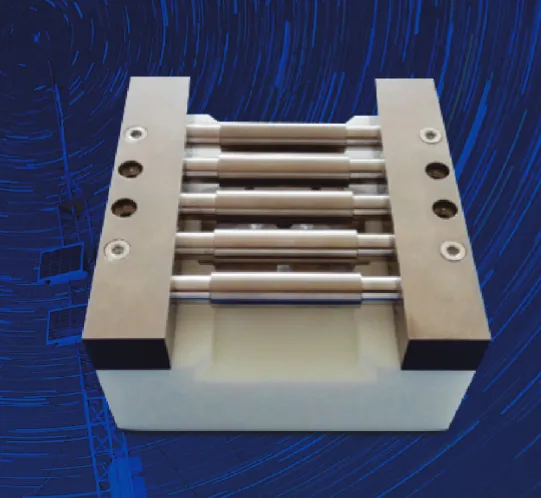
The Butane Micropropulsion Module uses non-toxic liquefied butane as the propellant, relying on self-pressurization and vaporization to achieve a compact cold-gas propulsion configuration. Integrated with control circuitry, the module supports plug-and-play operation. Its high-precision thrust output enables micro- and nano-satellites to perform fine orbit transfer, attitude control, and station-keeping maneuvers.
Key Specifications
| Parameter | Value |
|---|---|
| Dimensions (mm) | 100 × 100 × 100 |
| Mass (g) | 900 |
| Total Impulse | 200 N·s |
| Mounting Material | TC4 (Titanium Alloy) |
| Operating Temperature (°C) | 10–30 |
| Storage Temperature (°C) | 0–60 |
| Communication Interface | RS-422 / CAN |
Key Features
- Simple and reliable modular structure.
- Pre-packaged and plug-and-play capability.
- Lightweight and energy-efficient design.
- Modular architecture with strong scalability.
Applications
- Used for micro- and nano-satellite propulsion, providing precise thrust control for orbit transfer, attitude adjustment, and long-term station-keeping.
Documentation & Resources
Frequently Asked Questions
Common questions about Butane Micropropulsion Module
What propellant does the Butane Micropropulsion Module use?
It uses non-toxic liquefied butane, relying on self-pressurization and vaporization to form a compact cold-gas propulsion system.
What total impulse does the module provide?
The module delivers a total impulse of 200 N·s for precise orbit transfer, attitude adjustment, and long-term station-keeping.
What operating temperature range does it require?
The module operates within a narrow 10 to 30°C range and can be stored from 0 to 60°C.
What communication interface is available?
It communicates over RS-422 or CAN, in a 100 × 100 × 100 mm titanium-alloy (TC4) housing weighing about 900 g.
What missions is the butane module suited to?
It targets micro- and nano-satellite propulsion needing precise thrust for orbit transfer, attitude control, and station-keeping.