Visual Overview
Technical Details
Comprehensive specifications and technical information
Product Introduction
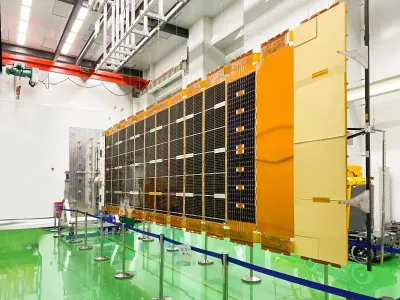
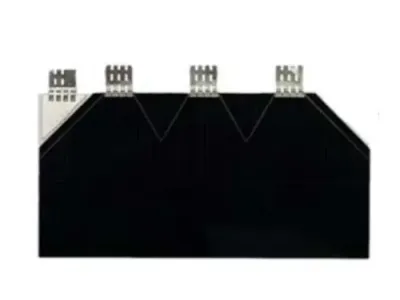
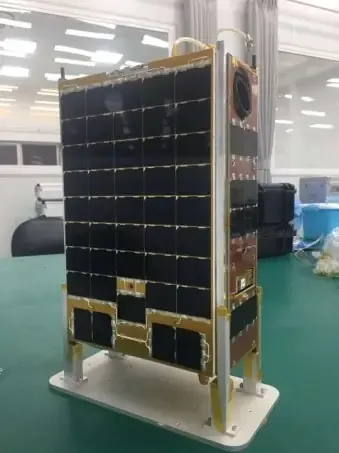
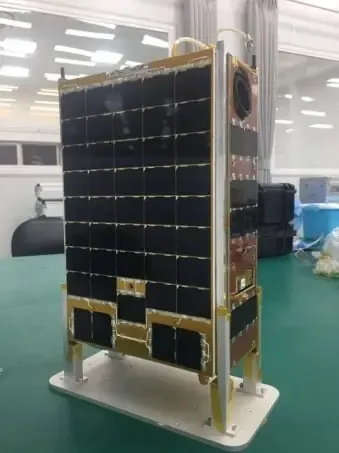
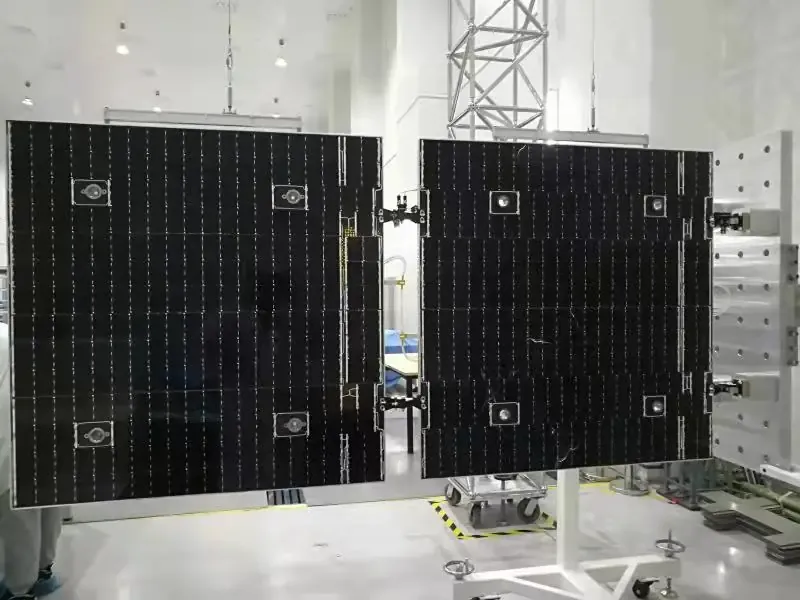
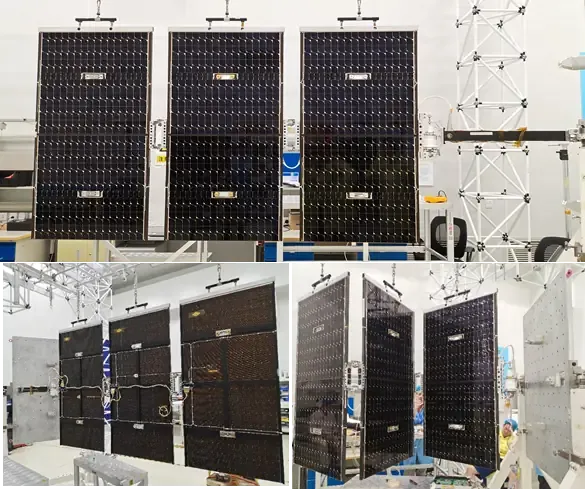
The Rigid Solar Array is composed of a solar cell array, substrate, expansion drive mechanism, pressing and unlocking mechanism, and other components. This array can achieve different expansion modes such as body mounting, single folding, and multiple folding, catering to the in-orbit energy supply needs of various types of space vehicles.
Product Image
Product Characteristics
- High Stiffness: The development process is stable, the product is mature and reliable, and the adaptability is wide.
- Fast Expansion: The array can be deployed in a few seconds, ensuring the safety of the entire spacecraft.
- Long Life: Stable in orbit, with a service cycle exceeding 15 years.
Technical Characteristics
| Solar Cells | |||
|---|---|---|---|
| Type | TJ28 | TJ30 | TJ32 |
| conversion efficiency (%) | 28.3 | 30 | 32 |
| thickness (mm) | 0.080/0.145/0.175 | ||
| Areal density ( g/m² ) | 430/850/940 | ||
| Short-circuit current density (mA/cm2) | 17 | 17.67 | 19.46 |
| Open-circuit voltage (mV) | 2650 | 2700 | 2590 |
| Current density at max. Power (mA/cm2) | 16.2 | 17.13 | 18.83 |
| Voltage at max. Power (mV) | 2340 | 2396 | 2280 |
| Panels | |||
| Type | PCB | Aluminium alloy | Carbon fiber aluminum honeycomb |
| thickness (mm) | 1.8 | 3/5 | 12/15/25 |
| Areal density ( kg/m2) | 4.5 | 5.5 | 2.5~3 |
| Key features | Short production cycle, 1U-12U standard interface design, extensible | Low cost | Light weight, high maturity |
| Release Device | |||
| Type | Explosive | SMA | Hot knife |
| Release time | <160ms | 1s~45s | <1min |
| Key features | Short unlocking time, high product maturity | Small impact, test reused, structure safe | Light weight, miniaturization |
| Driving Mechanism | |||
| Type | Volute spring hinge | Flexure hinge | Hinge hinge |
| Key features | High reliability and high deployment stiffness | Light weight, low cost | Flexible mechanical interface, light weight |
Typical Application
The Rigid Solar Array is ideal for custom panel manufacturing and high-volume manufacturing for CubeSats and SmallSats. These solar arrays provide reliable energy supply for:
- CubeSats: Small, cube-shaped satellites used for a variety of space missions.
- SmallSats: Miniaturized satellites used in research, communication, and observation.
- Space Vehicles: Various types of spacecraft requiring reliable energy sources for extended missions.
Discover more about our space energy solutions.
Frequently Asked Questions
Common questions about Rigid Solar Array for Spacecraft - High Stiffness & Fast Expansion
What unique spectral response advantages do multijunction solar cells offer for rigid spacecraft arrays compared to single-junction alternatives?
Multijunction solar cells are crucial for rigid spacecraft arrays because they efficiently convert a broader portion of the extraterrestrial solar spectrum into electrical power. By stacking multiple sub-cells, each tuned to absorb different wavelengths (e.g., a top cell for blue/UV, a middle cell for visible light, and a bottom cell for infrared), they maximize photon capture. This multi-bandgap approach significantly increases overall energy conversion efficiency compared to single-junction cells, which can only efficiently convert a narrower spectral range. For rigid arrays, this means achieving higher power density from a smaller, lighter footprint, reducing launch mass and volume while ensuring robust, high-performance power generation throughout the mission.
How does the energy efficiency of SolarWing's rigid solar array compare to that of flexible solar arrays, especially considering the trade-offs between stiffness and power generation?
SolarWing's rigid solar arrays offer excellent energy efficiency due to the high packing density of GaAs solar cells and minimal substrate losses. While flexible arrays can sometimes achieve comparable beginning-of-life efficiency, our rigid design maintains higher power output over the mission lifespan. The stiffness advantage allows for precise pointing and reduces vibrations, minimizing efficiency losses from off-axis sunlight. Furthermore, the robust structure minimizes degradation from micrometeoroid impacts, which can significantly impair the performance of flexible arrays over time, contributing to superior long-term energy production.
What missions is this product suitable for?
Perfect for CubeSats (1U-12U standard interfaces), SmallSats, and various space vehicles requiring reliable energy for extended missions. Supports body mounting, single folding, and multiple folding deployment modes for different spacecraft configurations and mission requirements.
How does this product compare to related products?
Compared to flexible arrays, offers superior stiffness, rapid deployment (seconds), and proven 15+ year operational reliability. Multiple solar cell options (TJ28-TJ32) provide higher efficiency (28.3-32%) than conventional rigid arrays, with diverse panel materials for optimal weight and performance balance.
What are the key technical advantages?
Exceptional high stiffness ensures stable deployment and operation, with rapid expansion mechanisms completing deployment in seconds. Advanced solar cell technology provides superior efficiency (28.3-32%) with optimized areal density (430-940 g/m²). Multiple release device options ensure reliable deployment.