Visual Overview
Technical Details
Comprehensive specifications and technical information
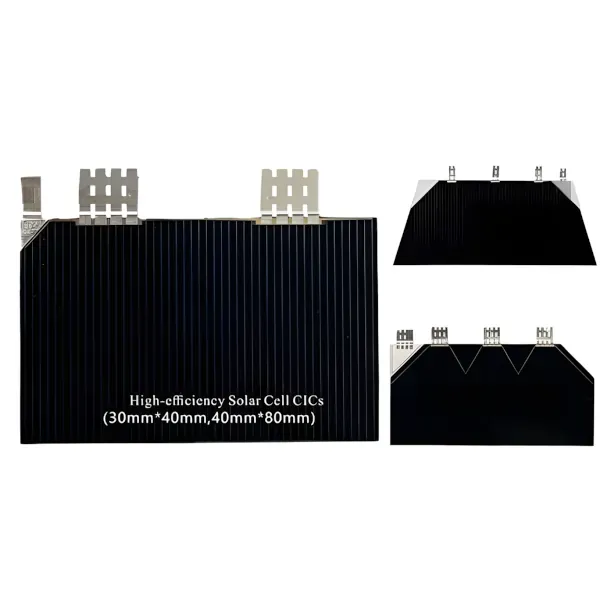
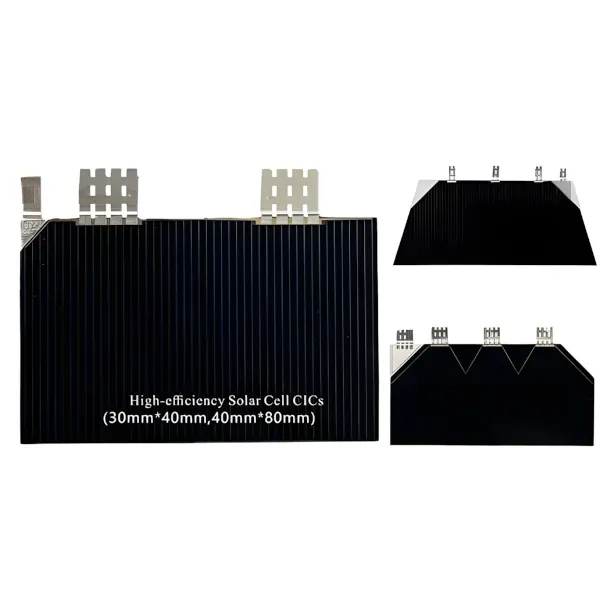
High-Efficiency Solar Cell CICs
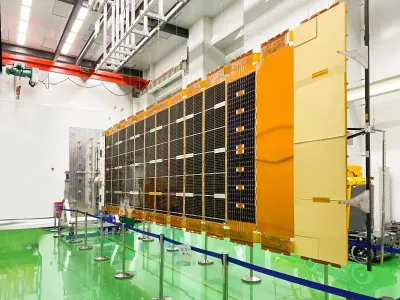
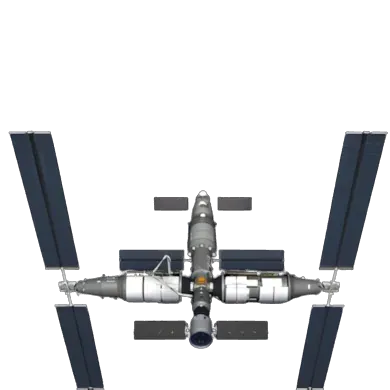
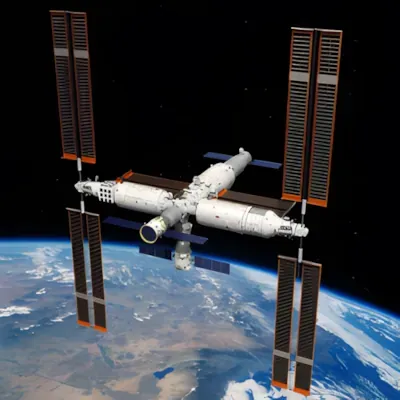
Explore our High-Efficiency Solar Cell CICs designed for satellite, space station, and deep space applications. Featuring advanced encapsulation technology, these solar cells offer high efficiency, long life, and exceptional radiation resistance.
Product Features
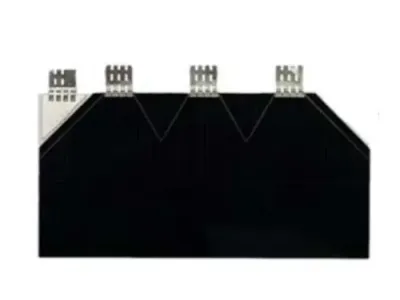
CIC (Coverglass Interconnected Cell) is a solar cell with interconnects encapsulated by glass cover for space use. It features a high efficiency of over 30% and a long lifespan of over 15 years. CIC adopts advanced encapsulation technology that effectively prevents adverse outer space effects on the solar cell.
Applications
- Application scenarios: satellites, space stations, deep space exploration, etc.
- Provides customizable high-efficiency, high-reliability aerospace products.
Parameters
High-Efficiency Solar Cell CICs
| Application Orbit | Working Temperature | Size | Weight |
|---|---|---|---|
| LEO, GEO, IGSO, Deep space exploration | -175°C to 110°C | Classic size: 40mm80mm, 67mm138mm (customizable) Thickness:300-254 μm (Cell thickness: 150-200 μm) Coverglass thickness: 120 μm | ≤ 115 mg/cm² |
Typical Performance Data
| Electrical Parameters @ AM0 (1353 W/m², T=25°C) | ||
|---|---|---|
| Efficiency η [%] | 30 | 32 |
| Open Circuit Voc [V] | 2.74 | 2.71 |
| Short Circuit Jsc [mA/cm²] | 17.4 | 18.7 |
| Current @ Max. Power Jm [mA/cm²] | 16.8 | 17.9 |
| Voltage @ Max. Power Vm [V] | 2.42 | 2.38 |
Radiation Performance at 1 MeV Electron Irradiation, EOL/BOL Ratios
| Fluence (e/cm²) | 1E14 | 5E14 | 1E15 |
|---|---|---|---|
| Voc/Voc0 | 0.96 | 0.94 | 0.90 |
| Isc/Isc0 | 0.99 | 0.97 | 0.94 |
| Pmp/Pmp0 | 0.96 | 0.89 | 0.84 |
Bypass Diode
| Type | Parameters |
|---|---|
| Forward Voltage (+2.5 A) | < 1.0 V |
| Reverse Current (-4.5 V) | < 0.7 mA |
Interconnector
| Type | Details |
|---|---|
| Sliver | Pull test at 45° (one point) > 1.6 N |
| Kovar, sliver coated | Pull test at 45° (one point) > 1.6 N |
Thermal Properties (CIC)
| Type | Details |
|---|---|
| Absorption Coefficient | < 0.89 |
| Hemispheric Emissivity | 0.82 ± 0.03 |
Temperature Gradients
| Type | Unit | η = 30% | η = 32% |
|---|---|---|---|
| Short Circuit Jsc | [μA/cm²/°C] | 12.0 | 11.0 |
| Open Circuit Voc | [mV/°C] | -5.6 | -6.0 |
| Current at Max. Power Jm | [μA/cm²/°C] | 9.0 | 10 |
| Voltage at Max. Power Vm | [mV/°C] | -5.8 | -6.3 |
For additional information on our high-efficiency solar cells or to discuss potential applications for your projects, please feel free to contact us.
Frequently Asked Questions
Common questions about High-Efficiency Solar Cell CICs for Space Applications
What are the key differences between beginning-of-life (BOL) and end-of-life (EOL) monocrystalline solar panel efficiency in space, and how does SolarWing account for this in its designs?
In space, monocrystalline solar cell efficiency degrades over time primarily due to radiation damage. BOL efficiency represents initial performance, while EOL efficiency reflects performance after a mission's duration. SolarWing's CIC designs factor in this degradation using radiation damage models specific to the intended orbit (LEO, GEO, etc.). We select cell materials and thicknesses, and incorporate coverglass shielding to minimize EOL efficiency loss. Our power output predictions are based on EOL performance, ensuring the spacecraft receives adequate power throughout its mission. We provide detailed radiation analysis reports with our products.
How does temperature affect the power output and efficiency of SolarWing's GaAs solar cell CICs in space?
Temperature significantly impacts solar cell efficiency. In space, without atmospheric convection, cells can experience extreme temperature variations. Higher temperatures reduce the band gap of GaAs, lowering the open-circuit voltage (Voc) and thus the overall power output. Our CICs are designed with temperature-compensating materials and processes to minimize these effects. Spacecraft thermal management systems are also crucial for maintaining optimal operating temperatures, maximizing efficiency and lifespan of the solar arrays. We provide detailed temperature coefficient data for accurate power prediction.
What missions is this product suitable for?
Designed for LEO, GEO, IGSO, and deep space exploration missions. Perfect for satellites, space stations, and long-duration spacecraft requiring high efficiency (>30%) and exceptional temperature tolerance (-175°C to 110°C) with proven 15+ year operational lifetime.
How does this product compare to related products?
Efficiency of 30-32% at AM0 exceeds conventional silicon space cells, and radiation resistance retains 84-96% of key parameters after 1×10¹⁵ e/cm² exposure. Advanced encapsulation protects the cell against the space environment for a service life of over 15 years.
What are the key technical advantages?
Stable temperature coefficients hold performance across a wide range (-175°C to 110°C). Bypass diode protection (<1.0 V forward voltage) and interconnectors rated >1.6 N pull strength support high reliability, with an absorption coefficient <0.89 and hemispheric emissivity of 0.82 ± 0.03.