Visual Overview
Technical Details
Comprehensive specifications and technical information
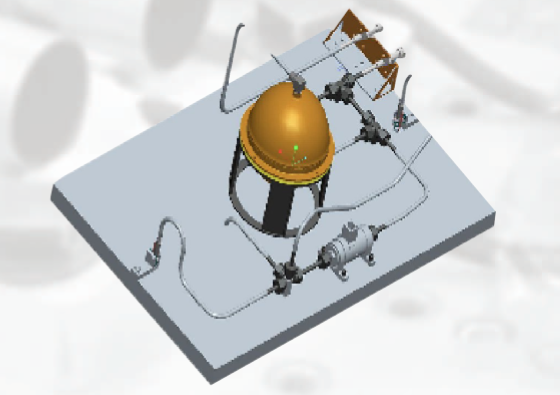
Tiny Satellite Position-Controlled Propulsion Module
Quick Overview
The Tiny Satellite Position-Controlled Propulsion Module is a compact monopropellant propulsion system using non-toxic ADN-based propellant. Designed for micro and small satellite constellations, it enables efficient orbit and attitude control with rapid integration, batch production capability, and cost-effective deployment.
Key Specifications
| Parameter | Value |
|---|---|
| Dimensions (mm) | 600 × 400 × 400 |
| Dry Mass (kg) | 3.6 |
| Propellant | ADN |
| Operating Temperature (°C) | 0–50 |
| Storage Temperature (°C) | −5–55 |
Key Features
- Monopropellant propulsion system.
- Utilizes a green, non-toxic ADN propellant.
- Supports pre-integration and modular delivery configuration.
Applications
- Successfully applied in the NX-1 satellite, meeting the requirements of small satellite constellation deployment, rapid integration, and low-cost assembly with proven flight experience.
Related Products
- See related products in this series
Documentation & Resources
Frequently Asked Questions
Common questions about Tiny Satellite Position-Controlled Propulsion Module
How does the accuracy of the star tracker impact the overall performance of the Tiny Satellite Position-Controlled Propulsion Module?
The accuracy of the star tracker directly affects the precision of attitude determination, which is critical for optimal propulsion module performance. A more accurate star tracker enables finer adjustments to the satellite's orientation, allowing for precise and efficient maneuvers, such as orbit maintenance or targeted changes. This translates to less propellant consumption and longer mission lifespans, as smaller, more accurate burns are possible.
What spacecraft platforms is this system compatible with?
This system is compatible with microsatellites, nanosatellites, CubeSats, and larger spacecraft platforms. It features modular design with standard interfaces for easy integration into various mission architectures and supports both commercial and scientific applications.
How does this system enhance spacecraft capabilities?
The system provides advanced functionality with reduced size, weight, and power consumption. It offers improved reliability through redundancy, radiation tolerance, and proven space-qualified components with extensive flight heritage.
What are the key performance specifications?
Key specifications include low power consumption, wide operating temperature range, high radiation tolerance (TID >100 krad), compact form factor, and long operational lifetime (>10 years). The system meets all relevant space qualification standards.
How is system integration and testing performed?
We provide comprehensive integration support including detailed interface specifications, test procedures, and simulation tools. All systems undergo thorough environmental testing, functional verification, and compatibility validation before delivery.