Visual Overview
Technical Details
Comprehensive specifications and technical information
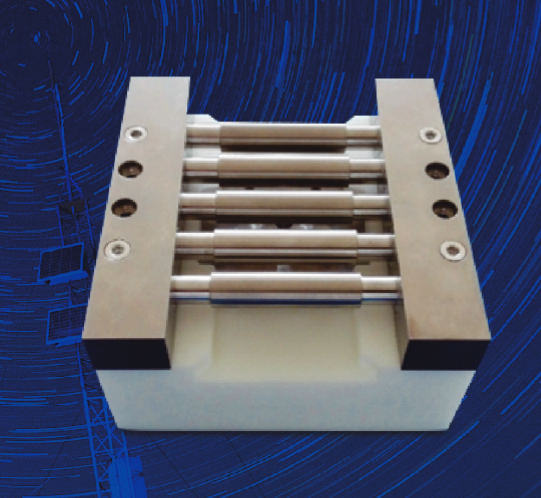
Butane Micropropulsion Module
Quick Overview
The Butane Micropropulsion Module uses non-toxic liquefied butane as the propellant, relying on self-pressurization and vaporization to achieve a compact cold-gas propulsion configuration. Integrated with control circuitry, the module supports plug-and-play operation. Its high-precision thrust output enables micro- and nano-satellites to perform fine orbit transfer, attitude control, and station-keeping maneuvers.
Key Specifications
| Parameter | Value |
|---|---|
| Dimensions (mm) | 100 × 100 × 100 |
| Mass (g) | 900 |
| Total Impulse | 200 N·s |
| Mounting Material | TC4 (Titanium Alloy) |
| Operating Temperature (°C) | 10–30 |
| Storage Temperature (°C) | 0–60 |
| Communication Interface | RS-422 / CAN |
Key Features
- Simple and reliable modular structure.
- Pre-packaged and plug-and-play capability.
- Lightweight and energy-efficient design.
- Modular architecture with strong scalability.
Applications
- Used for micro- and nano-satellite propulsion, providing precise thrust control for orbit transfer, attitude adjustment, and long-term station-keeping.
Related Products
- See related products in this series
Documentation & Resources
Frequently Asked Questions
Common questions about Butane Micropropulsion Module
What spacecraft platforms is this system compatible with?
This system is compatible with microsatellites, nanosatellites, CubeSats, and larger spacecraft platforms. It features modular design with standard interfaces for easy integration into various mission architectures and supports both commercial and scientific applications.
How does this system enhance spacecraft capabilities?
The system provides advanced functionality with reduced size, weight, and power consumption. It offers improved reliability through redundancy, radiation tolerance, and proven space-qualified components with extensive flight heritage.
What are the key performance specifications?
Key specifications include low power consumption, wide operating temperature range, high radiation tolerance (TID >100 krad), compact form factor, and long operational lifetime (>10 years). The system meets all relevant space qualification standards.
How is system integration and testing performed?
We provide comprehensive integration support including detailed interface specifications, test procedures, and simulation tools. All systems undergo thorough environmental testing, functional verification, and compatibility validation before delivery.
What documentation and support is available?
Complete technical documentation includes user manuals, interface control documents, test reports, and application notes. Our engineering team provides integration support, training, and ongoing technical assistance throughout the mission lifecycle.