Visual Overview
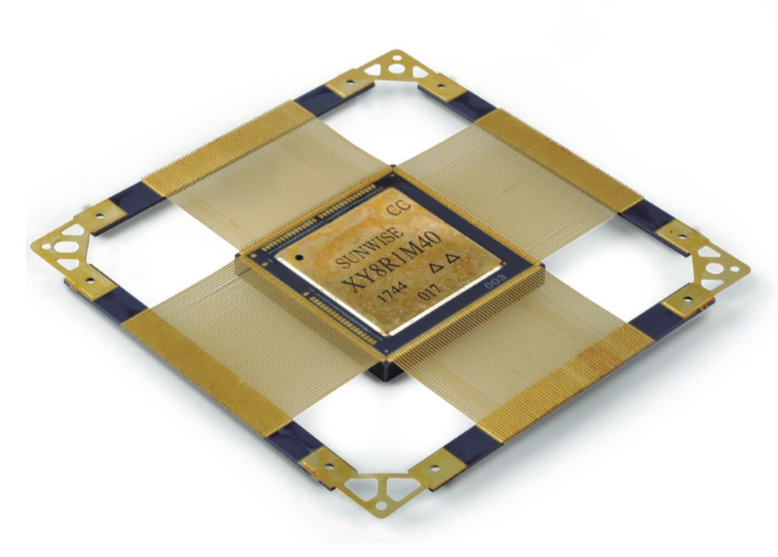
Technical Details
Comprehensive specifications and technical information
XY8R512K40/1M40 20M/40Mb Anti-Radiation SRAM
Quick Overview
The XY8R512K40/1M40 is a high-reliability, high-speed, asynchronous, low-power, radiation-hardened static random-access memory (SRAM) chip. Fabricated with 0.13 μm CMOS technology, it provides capacities of 20 Mb (512 K × 40 bit) and 40 Mb (1 M × 40 bit). The device serves as a general-purpose data storage chip suitable for aerospace computing control and data processing systems.
Key Specifications
| Parameter | Value |
|---|---|
| Process Technology | 0.13 μm |
| Dimensions (mm) | 29 × 29 × 3 |
| Capacity | 512 K / 1 M × 40 bit |
| Access Time | 22 ns |
| Operating Temperature (°C) | −55 to +125 |
| Package Type | CQFP132 / CFP84 |
| Quality Grade | CAST C |
Key Features
- High reliability, high speed, and asynchronous operation.
- Capacity of 512 K / 1 M × 40 bit.
- Access time of 22 ns with stable performance under radiation exposure.
- Designed for aerospace-grade data storage applications.
Applications
- Used in aerospace embedded electronic systems, first verified in orbit in 2019.
Related Products
- See related products in this series
Documentation & Resources
Frequently Asked Questions
Common questions about XY8R512K40/1M40 20M/40Mb Anti-Radiation SRAM
What spacecraft platforms is this system compatible with?
This system is compatible with microsatellites, nanosatellites, CubeSats, and larger spacecraft platforms. It features modular design with standard interfaces for easy integration into various mission architectures and supports both commercial and scientific applications.
How does this system enhance spacecraft capabilities?
The system provides advanced functionality with reduced size, weight, and power consumption. It offers improved reliability through redundancy, radiation tolerance, and proven space-qualified components with extensive flight heritage.
What are the key performance specifications?
Key specifications include low power consumption, wide operating temperature range, high radiation tolerance (TID >100 krad), compact form factor, and long operational lifetime (>10 years). The system meets all relevant space qualification standards.
How is system integration and testing performed?
We provide comprehensive integration support including detailed interface specifications, test procedures, and simulation tools. All systems undergo thorough environmental testing, functional verification, and compatibility validation before delivery.
What documentation and support is available?
Complete technical documentation includes user manuals, interface control documents, test reports, and application notes. Our engineering team provides integration support, training, and ongoing technical assistance throughout the mission lifecycle.