Visual Overview
Technical Details
Comprehensive specifications and technical information
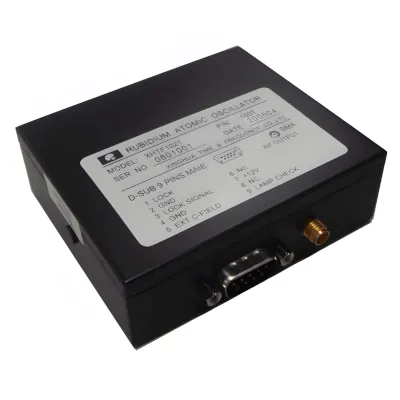
XHTF1021 Compact Rubidium Atomic Clock
Overview
The XHTF1021 Compact Rubidium Atomic Clock is a highly efficient and reliable timekeeping device that combines low power consumption, compact structure, and excellent synchronization capabilities. For inquiries, please contact us.
Features
- Compact structure for space-constrained applications.
- Low power consumption at +12V DC.
- RS-232C serial port for reliable communication.
- Supports 1PPS input synchronization and outputs a standard second signal.
Applications
- Widely used in aviation, aerospace, navigation, communication, and power industries.
Main Specifications
Core Specifications
| Specification | Typical | High performance | |
|---|---|---|---|
| Short-term Stability | 1s | <3E-11 | <1.5E-11 |
| 10s | <1E-11 | <5E-12 | |
| 100s | <3E-11 | <1.5E-12 |
| Specification | Typical | High performance | |
|---|---|---|---|
| Phase Noise (SSB) | @10Hz | <-100 dBc/Hz | |
| @100Hz | <-130 dBc/Hz | ||
| @1kHz | <-140 dBc/Hz |
| Specification | Typical | High performance | |
|---|---|---|---|
| Adjustment Range | Internal mechanical adjustment | ≥2E-9 | |
| External mechanical adjustment | ≥2E-9 |
| Specification | Typical | High performance | |
|---|---|---|---|
| 1PPS Input Sync Function (Optional) | 1PPS synchronization | ≤±50 ns | |
| Frequency accuracy | ≤1E-12/day (after one day discipline) |
Pin Connection Details
| Pin Number | Function | Pin Number | Function |
|---|---|---|---|
| 1 | Lock Status | 6 | NC or 1PPS Output |
| 2 | GND | 7 | +12V |
| 3 | NC or RXD | 8 | NC or 1PPS Output |
| 4 | NC or TXD | 9 | Lock Test |
| 5 | External Power Adjust | —— |
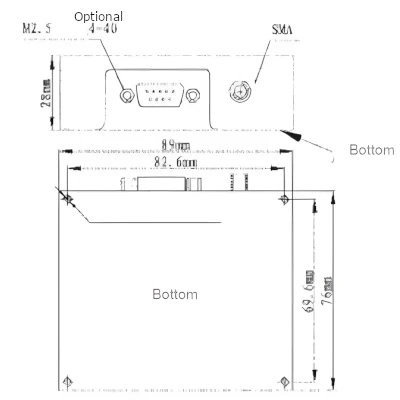
External Dimension
An external dimension of 89 × 76 × 28 mm, ensuring compact integration for various applications.
Frequently Asked Questions
Common questions about XHTF1021 Compact Rubidium Atomic Clock
What specific Kalman filtering techniques are recommended for the XHTF1021 to improve timekeeping accuracy when subject to short-term disruptions in space?
For optimal performance of the XHTF1021 in the space environment, we recommend implementing an Extended Kalman Filter (EKF) or an Unscented Kalman Filter (UKF) to estimate and correct for short-term frequency drifts and phase noise induced by environmental factors like temperature variations or radiation events. These filters can effectively leverage the clock's inherent stability alongside external measurements (e.g., GPS disciplined time) to maintain precise timekeeping even during brief periods of signal degradation or interruption. Proper tuning of the filter's process and measurement noise covariance matrices is crucial for optimal performance.
What applications require this atomic clock?
This atomic clock is essential for satellite navigation systems, deep space communications, scientific research, precision timing networks, and synchronization of distributed systems. It provides ultra-stable frequency references for critical space and ground applications.
How does this compare to other atomic clocks?
Our atomic clocks offer superior frequency stability, lower power consumption, compact size, and enhanced radiation tolerance compared to conventional designs. They maintain exceptional accuracy over extended mission durations in harsh space environments.
What is the expected operational lifetime?
The atomic clock is designed for 15+ years of continuous operation in space. It features redundant systems, radiation-hardened components, and proven reliability with extensive flight heritage on navigation satellites and deep space missions.
How is the clock synchronized and monitored?
The system includes comprehensive telemetry interfaces for real-time performance monitoring, remote diagnostics, and synchronization with ground stations. It supports standard timing protocols and provides detailed health status reporting.