Visual Overview
Technical Details
Comprehensive specifications and technical information
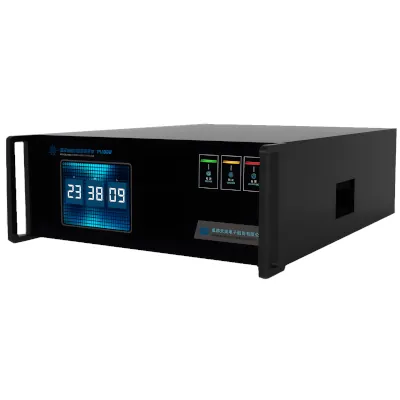
TA1000 Optically-pumping Cesium Atomic Clock
Overview
The TA1000 Optically-pumping Cesium Atomic Clock is designed as an optically pumped cesium-beam frequency standard. It offers outstanding stability and accuracy for both laboratory and field environments. With a 30-day averaging time stability specification, the TA1000 ensures long-term predictable performance for applications like time synchronization, telecommunications, and high-precision measurement systems. For inquiries, please contact us.
Features
- Touch-based menu-driven operation for ease of use.
- Advanced optically-pumped technology for high accuracy.
- Easy-to-read clock and message displays.
- Comprehensive status monitoring with automatic event logging.
- Supports automatic synchronization of 1PPS signals.
- Full clock and frequency control capabilities.
Main Specifications
General Specifications
| Specification | Details |
|---|---|
| Frequency Accuracy | ≤1E-12 |
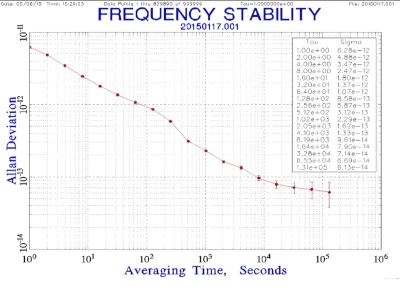
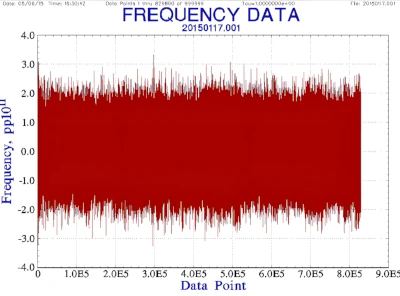
| Frequency Stability | ≤1.2E-11/1s ≤8.5E-12/10s ≤2.7E-12/100s ≤8.5E-13/1000s ≤2.7E-13/10000s ≤8.5E-14/100000s |
| Frequency Reproducibility | ≤5E-13 |
| Manual Sync Range | ±1E-9 |
| Resolution | 1E-15 |
| Power Voltage | 22VDC~75VDC 220V 50Hz VAC |
| Power Consumption | Warm-up: ≤190W Stable: ≤110W |
| Operating Temperature | -10°C to +40°C |
| Storage Temperature | -20°C to +50°C |
| Warm-up Time | ≤40min at +20°C ≤2 hours at -10°C |
| Weight | ≤40 kg |
| External Dimensions | 598 x 456 x 177 mm (19-inch, 4U) |
| MTBF | ≥100,000 hours |
| Atmospheric pressure | ≤5.0E-13/ sea level 0~3km |
| Magnetic field | ≤3.0E-13/ ±1 Gauss |
| Vibration | Be adapted to the 3rd class highway or railway transportation. |
| Service life | ≥8 years |
Output Signals
| Signal Type | Details |
|---|---|
| 10 MHz Sine Wave | Channels: 2 Amplitude: 7~13 dBm Harmonic: ≤-40 dBc Non-harmonic: ≤-80 dBc Phase Noise: @1Hz: ≤-90 dBc/Hz @10Hz: ≤-125 dBc/Hz @100Hz: ≤-140 dBc/Hz @1kHz: ≤-150 dBc/Hz @10kHz: ≤-150 dBc/Hz |
| 5 MHz Sine Wave | Channels: 2 Power: 7~13 dBm |
| 1PPS TTL | Rising time: ≤10 ns Jitter: ≤1 ns Sync accuracy: ≤20 ns Sync Input: 1PPS TTL |
Applications
- Calibration of counters, frequency meters, spectrum and network analyzers.
- References for DTV, DAB, VHF, UHF & PMR TX, CMDA, Tetra, and IPTV systems.
- Production test frequency standards.
- Network time protocol for financial, utilities, security, and communications.
- OEM and calibration labs, radio workshops, and test labs.
Frequently Asked Questions
Common questions about TA1000 Optically-pumping Cesium Atomic Clock
What applications require this atomic clock?
This atomic clock is essential for satellite navigation systems, deep space communications, scientific research, precision timing networks, and synchronization of distributed systems. It provides ultra-stable frequency references for critical space and ground applications.
How does this compare to other atomic clocks?
Our atomic clocks offer superior frequency stability, lower power consumption, compact size, and enhanced radiation tolerance compared to conventional designs. They maintain exceptional accuracy over extended mission durations in harsh space environments.
What is the expected operational lifetime?
The atomic clock is designed for 15+ years of continuous operation in space. It features redundant systems, radiation-hardened components, and proven reliability with extensive flight heritage on navigation satellites and deep space missions.
How is the clock synchronized and monitored?
The system includes comprehensive telemetry interfaces for real-time performance monitoring, remote diagnostics, and synchronization with ground stations. It supports standard timing protocols and provides detailed health status reporting.
What environmental conditions can it withstand?
The atomic clock operates reliably in extreme temperatures (-40°C to +70°C), high radiation environments, and zero gravity. It meets stringent space qualification standards for vibration, shock, and electromagnetic compatibility.