Visual Overview
Technical Details
Comprehensive specifications and technical information
Near Space Aircraft Energy System - Solar Array & Energy Management
Near Space Aircraft Energy System
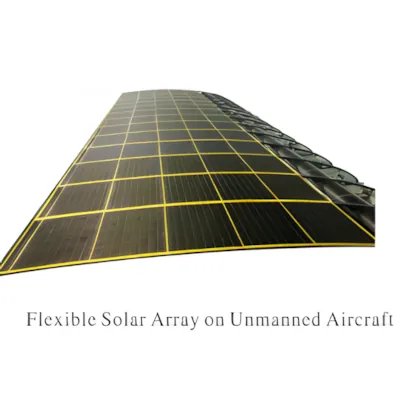
Explore the Near Space Aircraft Energy System designed for altitudes of 20 km to 100 km. Featuring a modular solar array, energy storage, and energy management, this system offers long endurance, low cost, and reliable energy solutions for unmanned airships and aircraft.
Product Features
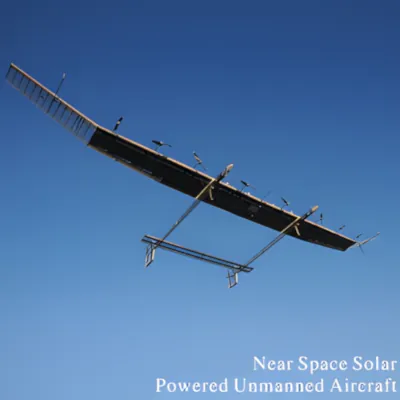
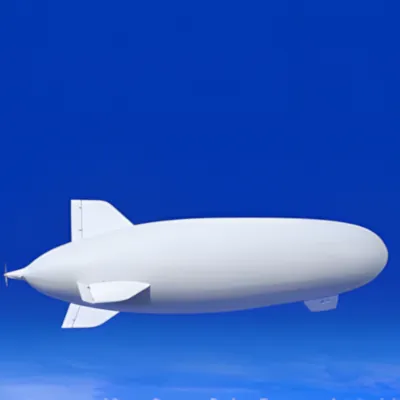
Near space refers to airspace at an altitude of 20 km to 100 km. Aircraft operating in this airspace are called near space aircraft, which mainly include stratospheric airships, floating balloons, and high-altitude, long-endurance airplanes.
Compared to traditional aircraft and satellites, near space aircraft have advantages such as long endurance, low cost, all-weather capabilities, and repeatable takeoff and landing. Additionally, they cannot be easily detected or attacked. These aircraft are widely used in fields like early warning detection, communication broadcasting, and electronic countermeasures.
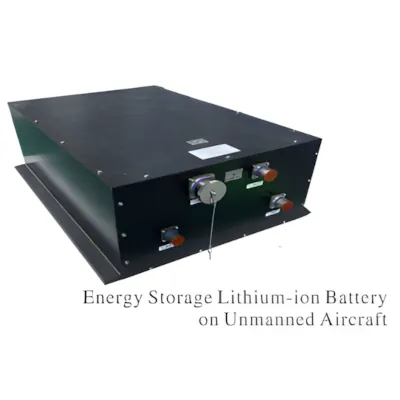
The company has constructed an energy system architecture comprising solar array, energy storage, and energy management. It adopts a distributed modular design, achieving a closed-loop system of “energy generation - energy storage - energy supply” for different aircraft. Learn more about .
Applications
- The products can be applied in high-resolution platforms for observing the Earth, 5G base stations for emergencies, and high-altitude communication relay platforms.
- The world’s leading solution provider and manufacturer for near space aircraft energy systems.
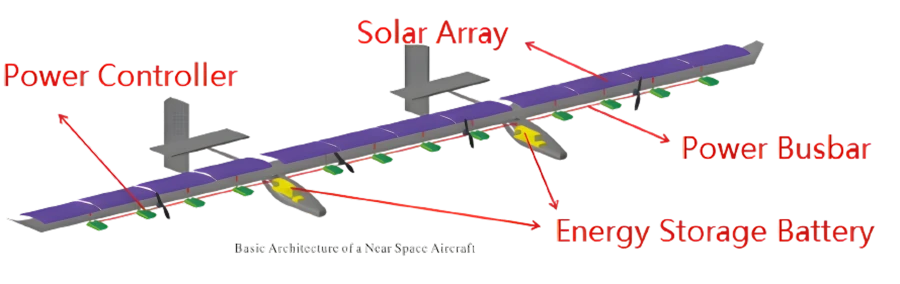
Basic Architecture of a Near Space Aircraft
- Solar Array
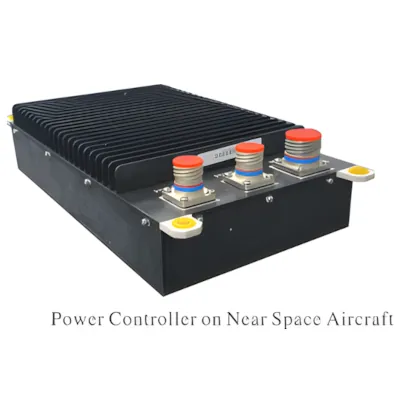
- Power Controller
- Power Busbar
- Energy Storage Battery
Parameters
| Configuration | Solar Powered Unmanned Aircraft Energy System | Solar Powered Unmanned Airship Energy System |
|---|---|---|
| Key Performance Parameters | ||
| Service Life | Calendar life ≥ 3 years | Calendar life ≥ 3 years |
| Flight Duration | ≥ 24h - 30 days | ≥ 24h - 90 days |
| Conversion Efficiency of Silicon Solar Array | 22.5% | 22.5% |
| Conversion Efficiency of High-Efficiency Solar Array | ≥ 30% | ≥ 30% |
| Maximum Discharge Rate of Energy Storage Battery | 1C | 3C |
| Energy Storage Battery System | High energy battery | High energy battery |
| Energy Density | 450 - 500 Wh/kg | 300 - 350 Wh/kg |
| Controller Operating Efficiency | 90% - 97% | 90% - 97% |
| Controller Weight to Power Ratio | 1.5 kW/kg - 2.5 kW/kg | 1.5 kW/kg - 2.5 kW/kg |
| Service Environment | ||
| Service Altitude | 0 - 30 km | 0 - 25 km |
| Service Temperature | -90°C to +70°C | -90°C to +70°C |
Frequently Asked Questions
Common questions about Near Space Aircraft Energy System - Solar Array & Energy Management
What is the expected lifespan of the deployable solar array on the Near Space Aircraft Energy System, and what factors most influence its degradation?
The expected lifespan of our deployable solar array is typically 10-15 years in Low Earth Orbit (LEO), though this can vary. Primary factors influencing degradation include radiation exposure (protons, electrons), thermal cycling during orbital passes, and micrometeoroid/orbital debris impacts. We mitigate these factors through radiation-hardened solar cells, robust deployment mechanisms designed for repeated cycles, and protective coatings to minimize atomic oxygen erosion in LEO. Regular monitoring of power output allows for proactive adjustments to energy management strategies as degradation occurs.
What missions is this product suitable for?
Ideal for stratospheric airships (20-25km altitude) and high-altitude long-endurance aircraft (0-30km altitude). Perfect for early warning detection, communication broadcasting, electronic countermeasures, emergency 5G base stations, and high-resolution Earth observation platforms requiring persistent surveillance.
How does this product compare to related products?
Superior to traditional aircraft and satellites with advantages including long endurance (24h-90 days), low operational costs, all-weather capabilities, and repeatable takeoff/landing. Distributed modular design provides complete "energy generation-storage-supply" closed-loop system unlike conventional power solutions.
What are the key technical advantages?
Exceptional solar array efficiency (22.5% silicon, ≥30% high-efficiency) with advanced energy storage systems (300-500 Wh/kg). High-performance controllers achieve 90-97% efficiency with excellent weight-to-power ratios (1.5-2.5 kW/kg). Operates reliably in extreme temperatures (-90°C to +70°C).
How does it integrate with other systems?
Modular architecture comprises solar array, power controller, power busbar, and energy storage battery for seamless integration. Distributed design enables flexible configuration for different aircraft platforms. High discharge rates (1C-3C) support various mission power requirements and payload systems.