Visual Overview










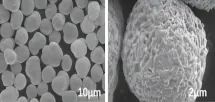
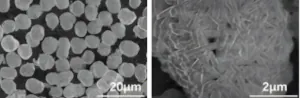
Technical Details
Comprehensive specifications and technical information
Ni-rich Cathode Materials for Lithium Ion and Sodium Ion Batteries
Ni-Rich Cathode Materials for Lithium Ion Batteries
Explore our state-of-the-art pack production line solutions for battery modules with advanced quality assurance, control, and comprehensive testing capabilities.
Product Features
The whole series of products have high energy density characteristics. Based on different application requirements, we provide a variety of products, each tailored to either high power or extended life. These materials are manufactured using state-of-the-art processes, ensuring quality and consistency. Learn more about
Parameters
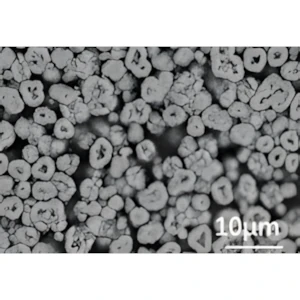
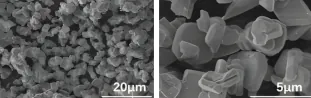
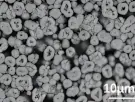
| Material Type | M811 Cathode Material | NCMA Cathode Material | Ultra-high Nickel Content Cathode Material |
|---|---|---|---|
| Parameters | Test results | ||
| Appearance | |||
| D₅₀ (μm) | 4.93 | 10.28 | 4.20 |
| Specific Discharge Capacity | 202.3 mAh/g 0.2C/0.2CD, 3-4.3V | 214.18 mAh/g 0.2C/0.2CD, 3-4.3V | 230.5 mAh/g 0.2C/0.2CD, 3-4.3V |
| Rate 5C/0.2C | 81.2% | / | / |
| Structure | Hollow | Divergent | Small particle agglomerate |
Cathode Materials for Sodium Ion Batteries
Product Features
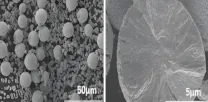
The whole series of products have the advantages of low cost, high energy density, and long life. We provide agglomerate and mono-crystal cathode materials that are ideal for sodium ion battery applications. Learn more about .
Parameters
| Material Type | Agglomerate NaNi₁/₃Fe₁/₃Mn₁/₃O₂ Cathode Material | Mono-crystal NaNi₁/₃Fe₁/₃Mn₁/₃O₂ Cathode Material | ||
|---|---|---|---|---|
| Coin cell (2.0-4.0V) | 0.2C Specific Discharge Capacity (mAh/g) | 141.3 | 0.2C Specific Discharge Capacity (mAh/g) | 138.7 |
| 1C Specific Discharge Capacity (mAh/g) | 136.5 | 1C Specific Discharge Capacity (mAh/g) | 132.5 | |
| 1C Cycle 50 Cycles Hold Rate (%) | 96.21 | 1C Cycle 50 Cycles Hold Rate (%) | 97.40 |
Raw Materials
Product Features
The materials used in the production of Ni-rich and sodium ion batteries are crucial to ensuring the efficiency and longevity of the final product. Below are the key raw materials used.
| Name | LiH₂PO₄ | NiSO₄·6H₂O | MnSO₄·H₂O |
|---|---|---|---|
| Appearance | Particle without clumping white crystal | Particle without clumping green crystal | Light pink powder without clumping |
| Appearance | |||
| Magnetic Impurity (ppb) | 30 | 31 | 30 |
| Oil Content (%) | 0.0003 | 0.0004 | 0.0004 |
| Insoluble Matter (%) | 0.0001 | 0.0001 | 0.0054 |
| pH | 4.01 | 4.63 | 5.63 |
| Applications | Used in preparation of high pellet density lithium iron phosphate | Used in production of precursor and nickel plating | Used in production of precursor Mn₃O₄ |
Applications
- Ni-rich Cathode Materials for Lithium Ion Batteries: Mainly used in civilian fields such as EVs, premium EVs, and premium electric tools, among other special equipment fields.
- Cathode Materials for Sodium Ion Batteries: Used primarily in low-speed electric vehicles, two-wheeled vehicles, and energy storage fields.
Frequently Asked Questions
Common questions about Ni-rich Cathode Materials for Lithium Ion and Sodium Ion Batteries
How does the use of Ni-rich cathode materials affect the radiation tolerance of lithium-ion batteries used in spacecraft?
Ni-rich cathodes generally offer higher energy density, which is crucial for space missions where mass is paramount. However, their radiation tolerance can be a concern. Radiation can induce structural changes in the cathode material, leading to capacity fade and reduced cycle life. SolarWing mitigates this through careful material selection, specialized coatings, and robust battery management systems designed to minimize radiation-induced degradation. Furthermore, shielding can be incorporated at the battery or spacecraft level, but this adds mass. We conduct extensive radiation testing to characterize and mitigate these effects.
What applications is this energy storage system designed for?
This system is designed for commercial rockets, reusable spacecraft, satellites, and space stations. It provides reliable power storage for launch vehicles, orbital operations, and deep space missions with proven performance in extreme environments.
How does this compare to other space-grade batteries?
Our energy storage units feature advanced battery management systems with intelligent SOC estimation, fault prediction, and autonomous thermal control. They offer higher energy density, longer cycle life, and better safety compared to traditional space batteries.
What are the main technical specifications?
The system supports multiple voltage platforms (32V, 160V, 270V, 400V), features fully enclosed integrated design, provides real-time health monitoring, and operates reliably across wide temperature ranges with excellent charge/discharge efficiency.
How is thermal management handled?
The system includes autonomous temperature control with active heating and cooling capabilities. Advanced thermal sensors and control algorithms maintain optimal operating temperatures, ensuring consistent performance and extended battery life in space conditions.